President Donald Trump signaled an expansive military campaign against Iran early Saturday and explicitly called for regime change in the Islamic Republic.
In a video posted on Truth Social, he confirmed combat operations aimed at “eliminating imminent threats” from Iran and recounted decades of aggression against U.S. forces at the hands the regime while also pointing out the tens of thousands of protesters who have been slaughtered in Iran in recent months.
Trump added that U.S. policy has been to prevent Iran from obtaining nuclear weapons and developing long-range ballistic missiles.
“For these reasons, the United States military is undertaking a massive and ongoing operation to prevent this very wicked, radical dictatorship from threatening America and our core national security interests,” he said. “We are going to destroy their missiles and raze their missile industry to the ground. It will be totally obliterated. We’re going to annihilate their navy. We’re going to ensure that the regime’s terrorist proxies can no longer destabilize the region or the world.”
In a nod to a potential prolonged operation, Trump also warned “we may have casualties—that often happens in war,” in contrast with recent attacks he ordered that resulted in minimal harm to U.S. personnel.
He then appealed directly to Iran’s armed forces and police, telling them will have “complete immunity” if they disarm. Otherwise, they face certain death.
Trump called on the Iranian people to shelter in place while bombs are falling but to “take over your government” once the U.S. finishes.
“This will be probably your only chance for generations. For many years, you have asked for America’s help, but you never got it,” he continued. “No president was willing to do what I am willing to do tonight. Now you have a president who is giving you what you want, so let’s see how you respond. America is backing you with overwhelming strength and devastating force. Now is the time to seize control of your destiny to unleash the prosperous and glorious future that is close within your reach. This is the moment for action. Do not let it pass.”
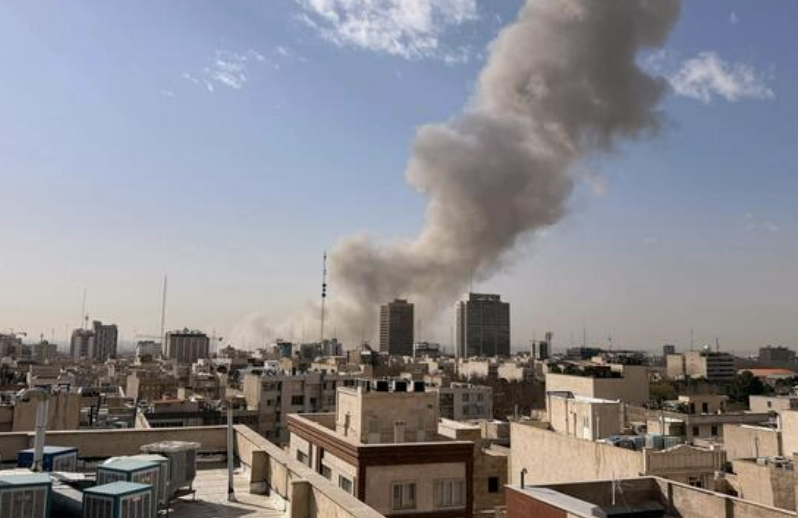
The message came after the U.S. and Israel launched attacks on Iran early Saturday after weeks of negotiations and the biggest military build-up in the region since the war in Iraq. The airstrikes follow the 12 Day War last June, when the U.S. joined Israel’s air campaign to target Tehran’s nuclear facilities.
While Trump had reportedly considered limited attacks on the regime, sources told CNN that the U.S. involvement was “not a small strike.”
Israeli Defense Minister Israel Katz described the attack as being done “to remove threats,” according to the Associated Press.
The AP also reported that one of the strikes took place near the office of Iran’s Supreme Leader, Ali Khamenei. Iranian state media reported strikes in Tehran, Isfahan, Qom, Karaj, and Kermanshah.
Since early January, the U.S. has moved enormous military assets to the region, including two aircraft carriers, several destroyers armed with guided missiles, fighters, bombers, and air-defense systems.
At the same time, Trump dispatched envoys to engage in indirect talks with Iran, demanding the country stop uranium enrichment as well as its ballistic-missile program. But he grew impatient with negotiations in recent days.
Trump had initially warned Iran last month again killing protestors calling for the end of the regime and vowed that help was on the way. But since then, he has sounded alarms about Tehran rebuilding its nuclear capabilities.
The latest U.S. strike on Iran represents a wider offensive compared to its June attacks that hit a few nuclear sites.
That’s despite Arab Mideast allies urging Washington to hold off on new attacks as Iran has indicated it would retaliate more aggressively this time, perhaps with medium-range missiles, drones as well as via proxy forces like Hezbollah.
Domestic backlash against the U.S. attack on Iran was swift after some members of Congress sought a vote on military action.
“Acts of war unauthorized by Congress,” said Rep. Thomas Massie, R-Ky., on X.
The latest attack on Iran also comes less than two months after the stunning U.S. raid on Venezuela that captured dictator Nicolas Maduro.
While the country’s leader was removed, Trump left the rest of the government in place and has been dealing with Maduro’s vice president.
The Venezuela raid was lasted hours, but early indications point to the Iran attacks being the start of a more expansive, longer offensive.
That’s after years of the U.S. depleting its stockpiles of munitions and also supplying Ukraine and Israel with weapons too.
Former Defense Secretary Mark Esper told CNBC before the Iran strikes that the U.S. is not prepared for an extended campaign or to support allies in a longer-term war.
“We simply don’t have the defense industrial base to do that, let alone the stockpiles of key weapons such as such as Patriot and THAAD and then strike weapons such as JASSMs,” he said Friday morning.
A wider U.S. offensive also risks roiling oil markets. After the limited U.S. airstrikes in June, crude prices briefly spiked but resumed a downtrend as Tehran’s response was also limited.
But given Trump’s new policy of regime change, Tehran could take more drastic measures to upend energy markets.
Iran pumped 4.7 million barrels per day last year, accounting for 4.4% of global oil supplies. Much of its heavily sanctioned shipments go to China via a so-called shadow fleet.
But the bigger risk centers on the potential for Iran to close off the Strait of Hormuz, where a fifth of all the world’s oil and liquefied natural gas (LNG) passes through on the way to export markets. Analysts have estimated that Iranian moves to close off the strait could send prices to $100 per barrel.